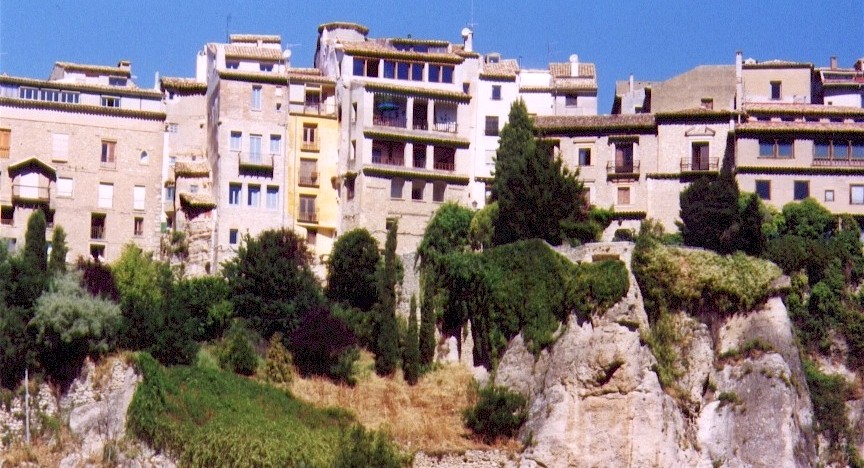
When we left Siguenza, we were headed for Barcelona although we didn't take a very
direct route. Our first stop was the city of Cuenca in the eastern extremes of La
Mancha. Cuenca is an old city surrounded by a much newer city. The old city has
a stunning location atop a narrow plateau between two gorges. This is the view across
the Huecar gorge. We parked here near the Parador (an old Dominican convent) and took
the footbridge across into the old city.

Cuenca's most famous site are the Casas Colgadas, or hanging houses. Several of them
now contain restaurants and one has an art museum in it. For the most part they are
built on the rock wall of the gorge and then partially cantilevered out over it. These
wooden balconies for instance, don't exactly look recently restored and are probably
not for the faint of heart. (The open-floor bridge across the gorge seems have to its own effect
on many people crossing it as well.)

Once inside the old town, the streets are narrow and almost all lead sharply up or
down. This is the cathedral in Cuenca, it is generally described (by both our guide
books) as one of the least attractive in Spain. The facade here is a little strange,
to be sure as it doesn't actually front the cathedral (especially on the upper half as
you can see) but we didn't find to be the architectural monstrosity it was described to
be.

This is one end of the Plaza Mayor, in fact that is the city hall (ayuntamiento)
above the arches. Old Cuenca seemed to be rather bustling and there are a wide
range of souvenir shops from the tacky to some rather impressive artisan's workshops.
At the base of the hill, the newer part of Cuenca is even busier and crammed full of
shops and restaurants, although parking looked like it might be near-impossible.
There are some very interesting street-like contraptions along the two sides facing the
gorges. Some of these streets are built nearly over the roofs of buildings below them.

The two rivers that flow into Cuenca (the Huecar and the Jucar) come out of the mountains
above the city (the Serrania de Cuenca). This area is extremely popular for camping,
hiking and general sight-seeing. The Ciudad Encantada is a loop through some
unusual rock formations. This view is of the Jucar from an overlook called La Ventana
de Diable (Devil's Window). Far down below (not visible in this picture) is a waterfall
which cascades into a beautiful swimming hole. If you're driving through this way, shortly
past La Ventana de Diable is a pull out and a small trail head to Los Banos which leads
down (way way down). Past this point the roads become more rugged as they head into the
Montes Universales.