Driving into southern Aragon from the Juecar gorge involves a tiny winding gravel road
that can be extra slow if you happen to be following two campers. As soon as you cross
into Aragon the road becomes paved and not much past that is this oddity. To be
completely honest we have no idea what this is. It is located at a small roadside
picnic area in the Montes Universales near the headwaters of the Tagus (or Tajo) river.
That would be the course of the Tagus etched into that map of Spain next to this statue.

Aha, it gets weirder, there are assorted peripheral statues nearby like the bull
here. Also notice the trendy snowflake crown. Anyone who knows more about this
odd little monument in the woods, please email us and let us know.

So the first real town we hit in Aragon was Albarracin which is an incredible medieval
village. It's a town like this that makes you realize how overused the phrase 'medieval
village' really is. Albarracin is stretched along a rocky ridge and coming from La Mancha
you actually drive through a tunnel under the town. Parking is at the base of the hill
and steep staircases wend up into the narrow alleys of the town.

Albarracin has only about 1000 people. From 1012 to 1104 it was the capital city
of Banu Razin, a tiny Berber/Islamic nation. From 1170 to 1285 it was an independent
Christian nation. Now it is tucked away quietly in an unused portion of Aragon.
Actually, there were spaces for tour bus parking in the public parking lot beneath the
city but we didn't see any during our visit so we're not sure how often people come here.
There isn't a lot of commercial action, just a couple souvenir shops scattered around
a handful of hotels and restaurants.

If you approach Albarracin from the direction of Teruel you'll see the city walls
stretching high across the hill long before you see the town. These walls are open
to the public although we did not make the long climb up. There is a separate castle
and set of walls on the other side of town as well (visible in the first Albarracin
picture).

We think Albarracin is best seen by wandering aimlessly. The buildings generally
lack any semblence of a straight line or a right angle as you can see here. There is
only one real public square inside Albarracin, it is near the city hall and we sat
at one of the two cafes there and had a platter of local ham and a couple of beers.
Honestly, Albarracin didn't offer very good people-watching opportunities because
it was mostly deserted, but the atmosphere is fantastic and it was much cooler at
the relatively high altitude Albarracin sits at than it was down on the plains.

Teruel is the capital of Aragon's southernmost region and it is best known for the four
Mudejar towers located in the city. Mudejar refers to Muslim people who stayed behind
when the Christians recaptured portions of Spain. It also refers to the art and the
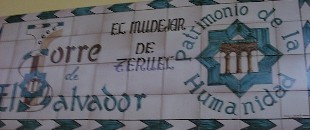
architecture they influenced. This is perhaps the best restored of the four towers,
the Torre de El Salvador.

Originally this was a minaret, which is still apparent if you go up inside the tower
which is definately worth the small fee. The stairs to the top spiral between the
original minaret and the newer (as in 14th century new) square tower built around it.
The center of Teruel is a crowded confusing place and sometimes the towers are obviously
visible (like here) but difficult to actually reach.

This is the Torre de San Pedro, or at least we think it is. To be
fair, the towers are not easily distinguishable from photographs several weeks after
you get back. Attached to this tower is the tomb of Diego and Isabel, Aragon's homegrown
version of Romeo and Juliet with less obvious causes of death (grief, for instance).
From Teruel it isn't too far back to Valencia, and from Valencia it's about three
hours back to Barcelona. Since we already covered that terrain at the beginning
of the trip, we can skip right to Barcelona now.