Everglades

The photos on this page are primarily from a trip taken in February 2003
although we've included some older pictures as we've been traveling to the
Everglades and surrounding region regularly for many years. Most of the
commentary is sort of our collective opinion and advice to those who are
visiting for this first time.

The Everglades is basically a very wide, very shallow river flowing from
the Lake Okeechobee basin southwest to the Gulf Of Mexico. Most
of the Everglades is a vast featureless marsh. It might look like there
are features in this photo but one clump of pines and palmettos looks
very like another after a few hours of hiking or paddling.

Unlike many national parks, the Everglades has no one awesome dominating
sight to see. There is no real postcard view of the place, in fact
very few geographical features even have names. That is partially because
it changes rather quickly compared to a mountain landscape. Hurricanes,
forest fires and the mobility of mangrove islands mean that a section
of the Everglades might look substantially different than it does now in
just a few years. This boardwalk is at Mahogany Hammock, one of the more
stable areas in the park and the only easy access to a hammock environment.
A hammock in this case is a mound that is a few inches higher than the
surrounding marsh, and thus larger foliage can survive there leading to a
sort of mini-jungle.

There is an area in Everglades national park called the Pinelands which is a
relatively high stable forest area primarily composed of pines. The rest
of it is marsh although there are subtle variations. This area is a coastal
prairie or salt marsh. If you were to walk across this it could easily go
from solid sandy ground to a few inches of mud and water to a deep pool.
This makes backcountry hiking more or less impossible. In fact, backcountry
hiking in the Everglades is technically known as slogging and there are ranger
led tours available if you want to learn the finer points of it.

If you aren't visiting the Everglades for an outdoor experience unlike
any other in the United States, you must be visiting for the wildlife.
It's out there but it's hard to find, or you can just go to the Anhinga
Trail (first turnoff after the main entrance) where the National Park
Service has conveniently collected quite a lot of it and built a boardwalk
around it for you. There are always plenty of alligators, wading birds,
turtles, fish and raptors around this part of the park. These animals
are not tame however, on this visit one of the gators had wandered up to
the gift shop and taken up residence just outside the door, effectively
closing it.

Perhaps the most distinctive bird in the Everglades is the Anhinga. The
white markings on its wings make it easy to spot and it tends to display
its wings prominently, usually holding them out to dry after swimmng.
This bird actually spears fish on the end of its bill and then pulls them off
to be consumed.

Needless to say they are excellent swimmers. We have been canoeing
and seen anhingas swim past under the water looking much more like a
fish (albeit with feathers) than a bird. Unfortunately we don't have
a picture of that.

At dusk anhingas (and egrets, herons, etc..) tend to clump together
in a few select trees and grassy areas that for some reason are superior
bird clumping areas. One of these is Eco-Pond near Flamingo. Flamingo
is a 'town' 40 miles into the National Park from the main (east) entrance.
It's really a small lodge, a general store, some boat tour operators and
a campground. It is a superior campground to those in the Pinelands area
for a couple reasons, one of which is Eco-Pond at dusk. As night falls
all sorts of birds return to this little pond which is an easy walk from
the campground, and even if you don't visit in person you'll be able to hear
it from some distance away.

There area great variety of birds in the Everglades, these are cormorants
which are closely related to the anhinga. Having lived in Florida for
many years we are desensitized to most of them though as they often wander
through our backyard so lets move on to reptiles.

This really means alligators. Sure there are zillions of turtles and
they're easy to come across but most people coming to the Everglades
want to see an alligator. Alligators are common in most of Florida
but the easiest spot to see big ones is at the Anhinga Trail boardwalk.
For true alligator lovers out there, other good sites in Florida include
Highland Hammocks State Park, Paynes Prairie south of Gainesville, the
Loxahatchee River near West Palm Beach and other parts of the Everglades
including the fairly accessible canal area just outside Flamingo.

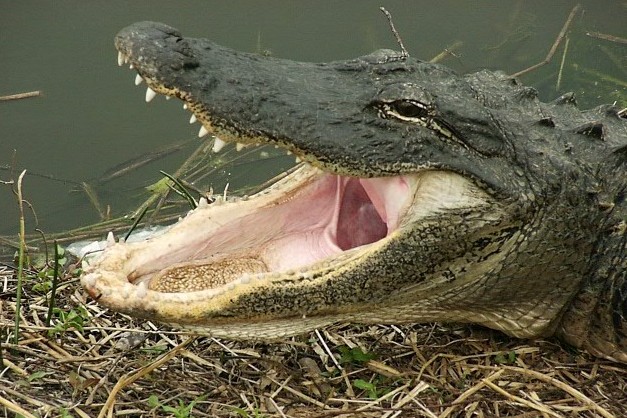
First to deal with the standard myths: Alligators are dangerous. As
you can see from this one they have exceedingly sharp teeth. They're
much faster than you in the water (and on the land for short distances)
and they have unbelievable strong jaw muscles (for biting down). On
the other hand they generally want nothing to do with you. We have seen
hundreds if not thousands of alligators hiking, biking and paddling across
the state and have never been approached by one. We have however had them
drift along the wake of a canoe or kayak which they seem to like to do for
some reason but this was generally non-threatening.

There do tend to be alligator-related deaths periodically, mostly to small
children. Do not approach an alligator, don't go swimming where they are
clearly hanging about and don't ever try to feed them a hot dog on the end
of a stick (this actually happened while we were camping at Flamingo once).
There are five in this picture (at least) this is generally the most you'll
ever see of an alligator in the water.

There are two exception to the live and let live philosophy between
alligators and humans. The first is dogs. We're told that alligators
consider dogs to be a bit of a delicacy and there is at least anecdotal
evidence to back it up. We've never really pushed the envelope, our dog
stays home on freshwater canoe trips. The second exception is babies (young
alligators that is). This is an extremely young alligator that we had the
good fortune to be able to photograph with a serious zoom lens. That is
the very tip of mom's tail in the bottom left corner. Nesting season tends
to be January and it's not a good time to go randomly stomping through
marshlands. Alligators mate and nest on land.

Here is one of his siblings. There were a few more around and probably
more that we couldn't see. Most of them won't survive to adulthood,
being easy prey for just about everything (including other alligators).
In this picture, those are individual blades of marsh grass. This baby
alligator was probably less than 6 inches (15 cm) long.

There are some mammals in the Everglades; deer, bear and a horde of intelligent
raccoons that assault the campground in Flamingo every night. The important remaining
wildlife group however is insects. There are a wide variety of spiders, most of which
are not poisonous (but often still painful) and there are the mosquitoes. The campground
check-in center at Flamingo has a six-level mosquito scale which has entries like 'Annoying'
and 'Aggravating'. The 5th level is 'Blood Sponge'. There is no avoiding them so you
should accept it and cover yourself in Deet - this includes under your clothing because
they will happily bite through t-shirts. We have seen reports as bad as 60 bites per second
on unprotected skin. The keys to lessening the mosquito impact are staying inside (a tent
for instance) at dusk and dawn as it's actually not quite as bad after dark, wearing baggy
clothing that covers as much as possible, and staying in areas where there is a wind
(which basically means the coast).

Now to paddling which is the primary outdoor activity in the Everglades. Of course
the grandaddy of paddling trips is the 99-mile Wilderness Waterway which takes about
7 to 10 days to complete. Alas, we've never had the time available to devote to that
so we've done quite a few day trips instead. The Flamingo area is interesting but
fairly full of other boats so some of the canoe/kayak exclusive areas a bit north
of Flamingo are better trips. This is Nine Mile Pond which has an extensive canoe
trail loop through it. This area is open water, once you get back in behind the first
row of mangroves it tends to be choked with weeds making for difficult paddling. This
trail is fairly well marked however so you're unlikely to get lost.

Also a good trip is a canoe launch on the west side of the road a few miles north of
Flamingo. There is no sign, but there is an obvious launch site into a tunnel between
mangroves. It leads out eventually to Hell's Bay Chickee which is about 5 miles
away. A chickee is an elevated platform which is nice for camping purposes in the
Everglades. Along the way you'll pass one other chickee (about 4 miles from the put-in)
and a solid ground campsite called Lard Can (about 3 miles in) shown here.

Following the Hell's Bay trail is difficult. PVC pipes have been stuck in the water
or the mangroves with numbers on them but the tides and the islands themselves make
it hazardous and inevitable that some of them will be missing. Get a good map and be sure
you know how to read it. Many of the islands are moveable. In fact you can push some
of them around with a paddle so many of the apparent paths through them are in fact
rather temporary. Lard Can is a little clearing on an island in a fairly open section
of the trail. We've found it to be a nice lunch spot if you can deal with the mosquitoes.
Consider using mosquito netting to encase your entire dining area [or canoe].

The Everglades contains many hiking trails most of which are short. Those in the Pinelands
section are longer but fairly uninteresting. The most isolated trail in our experience
is the Coastal Prairie Trail. The trailhead is at the far western end of the Flamingo
campgrounds from whence it winds 7.5 mi (12 km) one way to Clubhouse Beach where it ends.
Don't expect a tropical paradise of a beach, it's mostly mud flats and it's absolutely
covered with crabs (sit in one place for a few minutes without moving and you'll see them
start to come out of the sand). On the other hand it is nearly always deserted and the
only evidence of humans you'll see is the occasional sailboat out amongst the keys.

Much of the trail winds through coastal prairie like this section here. Some of it goes
through wooded sections where one should be aware of the abundant cacti in the area
should one need to go off the trail. Ahem. When we hiked this trail (on a holiday
weekend mind you) there was one other set of human footprints in the sand and about
a hundred sets of raccoon tracks (and a few raccoons making them) plus some sort of cat
tracks that probably belonged to a bobcat. Bring lots of water, lots of bug-spray, and
lots of protection from the sun but then that applies to the whole park for the most part.