 After we left Gruyeres we went in search of more castles which
brought us to the most visited in Switzerland: Chillon. Chillon
sits in Lake Geneva (Lac Leman) just south of the resort town of
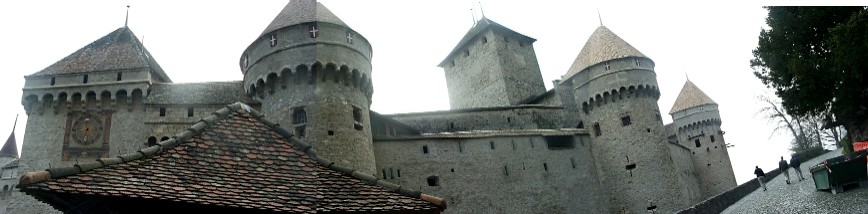
Montreaux. The strangely angled panorama above is from the front
of the castle (it's hard to get a good view from farther away).
The castle dates from the 11th century
and has been expanded extensively at every historical period since then.
It has also been nearly continuously occupied ever since.
After we left Gruyeres we went in search of more castles which
brought us to the most visited in Switzerland: Chillon. Chillon
sits in Lake Geneva (Lac Leman) just south of the resort town of
Montreaux. The strangely angled panorama above is from the front
of the castle (it's hard to get a good view from farther away).
The castle dates from the 11th century
and has been expanded extensively at every historical period since then.
It has also been nearly continuously occupied ever since.
 Lake Leman lies by Chillon's walls:
 A thousand feet in depth below
Its massy waters meet and flow;
Thus much the fathom line was sent
From Chillon's snow-white battlement
That's a verse from the poem that made this dungeon famous, 'The Prisoner of Chillon' by Lord Byron. The prisoner in question was Francois de Bonivard who was chained here for 5 years in the 16th century for preaching the Reformation. On his visit, Lord Byron supposedly scratched his name in the pillar that Bonivard was chained to, and now his graffiti is an attraction of its own (a very very minor attraction). This dungeon is located at lake level in the rear of the castle making escape rather unlikely. Due to the very dim lighting this photo was a long term exposure, hence the reddish cast.
 Lest we think that all of the most impressive man-made structures in Switzerland
are 700 years old, there is this view of the Autoroute between Montreaux and
Villenueve above the castle. It's actually quite an impressive piece of engineering
given the steepness of the cliff and the size of the supports.
Lest we think that all of the most impressive man-made structures in Switzerland
are 700 years old, there is this view of the Autoroute between Montreaux and
Villenueve above the castle. It's actually quite an impressive piece of engineering
given the steepness of the cliff and the size of the supports.  The self-guided tour of Chillon (available in a slew of languages) is extensive
and can easily take half a day. At the end is an optional climb of the central
tower. This involves many platforms and a decent view of the various structures
below.
The self-guided tour of Chillon (available in a slew of languages) is extensive
and can easily take half a day. At the end is an optional climb of the central
tower. This involves many platforms and a decent view of the various structures
below.  The tour includes period rooms ranging from the kitchen (circa 1300) to the Hall
of Arms which features the coat of arms of every resident bailiff through the mid
1800s. Before the bailiffs, the castle was ruled by a Count whose bedroom, chapel
and great hall are intact as well.
The tour includes period rooms ranging from the kitchen (circa 1300) to the Hall
of Arms which features the coat of arms of every resident bailiff through the mid
1800s. Before the bailiffs, the castle was ruled by a Count whose bedroom, chapel
and great hall are intact as well.  This is the city of Montreaux which in the summer is a fairly expensive lake resort.
Montreaux, and nearby Vevey, have been drawing tourists (particularly the British) since
1800. The town itself has a lot of restaurants, a lot of shopping, and a statue devoted
to Freddie Mercury (who apparently lived here for a while). In the summer, boats cover the
lake connecting Montreaux to other destinations via water.
This is the city of Montreaux which in the summer is a fairly expensive lake resort.
Montreaux, and nearby Vevey, have been drawing tourists (particularly the British) since
1800. The town itself has a lot of restaurants, a lot of shopping, and a statue devoted
to Freddie Mercury (who apparently lived here for a while). In the summer, boats cover the
lake connecting Montreaux to other destinations via water.  Here a small river has been funneled between the high-rise apartments that look
out over Lake Geneva and the nearby Alps. There is a rather pleasant walking
path along the lake through Montreaux although a few topiary artists might have
gotten a bit too creative perhaps. Not far south of Montreaux and Chillon, the lake
curves west into France. Most of the southern shore is French except for the extreme
southwestern corner where the city of Geneva lies.
Here a small river has been funneled between the high-rise apartments that look
out over Lake Geneva and the nearby Alps. There is a rather pleasant walking
path along the lake through Montreaux although a few topiary artists might have
gotten a bit too creative perhaps. Not far south of Montreaux and Chillon, the lake
curves west into France. Most of the southern shore is French except for the extreme
southwestern corner where the city of Geneva lies. 
 North along the lake is unbelievably scenic. Clustered along this route is the
town of St. Saphorin. There is nothing particularly special about St. Saphorin
compared to the other towns between Vevey and Lausanne, but it happens to be the
one where we stopped the car and wandered around a bit. While it doesn't show up
well in these pictures, the stone terraces going up the hills are covered in
vineyards. This area on the east side of Lake Geneva is one of the primary Swiss
wine-making regions. The road is pinned between these terraces and the lake. Just
across the lake, the Alps can be seen stretching to either horizon.
North along the lake is unbelievably scenic. Clustered along this route is the
town of St. Saphorin. There is nothing particularly special about St. Saphorin
compared to the other towns between Vevey and Lausanne, but it happens to be the
one where we stopped the car and wandered around a bit. While it doesn't show up
well in these pictures, the stone terraces going up the hills are covered in
vineyards. This area on the east side of Lake Geneva is one of the primary Swiss
wine-making regions. The road is pinned between these terraces and the lake. Just
across the lake, the Alps can be seen stretching to either horizon. 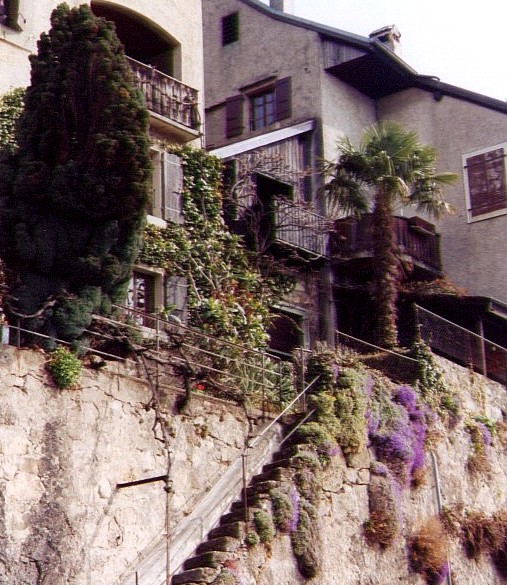
 By design or accidentally the locals have done their part to contribute to the
scenery. Most of the houses are decked out in various clinging flowering vines
and the rivers are channeled (partially for irrigation of course) into cascades
like this one.
By design or accidentally the locals have done their part to contribute to the
scenery. Most of the houses are decked out in various clinging flowering vines
and the rivers are channeled (partially for irrigation of course) into cascades
like this one. 
 This is the center of the city of Lausanne and their open-air market on a Saturday
morning. Lausanne is home to the largest University in Switzerland, one of the world's
premier culinary institutes and is the headquarters of the Olympics (or at least the
International Olympic Committee).
This is the center of the city of Lausanne and their open-air market on a Saturday
morning. Lausanne is home to the largest University in Switzerland, one of the world's
premier culinary institutes and is the headquarters of the Olympics (or at least the
International Olympic Committee).  Lausanne features an impressive cathedral of course which in all fairness is not
particularly different from other major Swiss cathedrals. There is more French
influence than German here but you'll have to look for those differences to notice
them. Unusual for a major cathedral, Lausanne's Notre Dame is crammed into the
old part of town on a raised terrace. The spire is visible from everywhere in the
city but most of the rest of the exterior can only be seen from the immediate vicinity.
Lausanne features an impressive cathedral of course which in all fairness is not
particularly different from other major Swiss cathedrals. There is more French
influence than German here but you'll have to look for those differences to notice
them. Unusual for a major cathedral, Lausanne's Notre Dame is crammed into the
old part of town on a raised terrace. The spire is visible from everywhere in the
city but most of the rest of the exterior can only be seen from the immediate vicinity.
 Lausanne is also home to one of the most interesting museums we have ever been to, the
Collection de L'Art Brut. There is no particular theme here amongst the work itself
but the artists all share something in common. None of them have had any formal art
training, and the vast majority spent time in mental institutions (or should have).
Reading the short biographies of the artists is worth the trip alone. One sculpture
was carved by a man in a cell with the handle of his spoon. When they took his spoon
away he began using a pot handle instead. One loft in the museum contains excerpts
from a 19,000 page illustrated novel discovered in a Chicago apartment after the man
who lived there (unknown to his neighbours) died. Another woman drew onto a huge scroll
of paper in near darkness and due to the cramped space she was in, never actually saw her
drawing unrolled. It just gets stranger after that.
Lausanne is also home to one of the most interesting museums we have ever been to, the
Collection de L'Art Brut. There is no particular theme here amongst the work itself
but the artists all share something in common. None of them have had any formal art
training, and the vast majority spent time in mental institutions (or should have).
Reading the short biographies of the artists is worth the trip alone. One sculpture
was carved by a man in a cell with the handle of his spoon. When they took his spoon
away he began using a pot handle instead. One loft in the museum contains excerpts
from a 19,000 page illustrated novel discovered in a Chicago apartment after the man
who lived there (unknown to his neighbours) died. Another woman drew onto a huge scroll
of paper in near darkness and due to the cramped space she was in, never actually saw her
drawing unrolled. It just gets stranger after that.