Bern

The city of Bern sits on a small promontory carved out by a U-shaped
bend in the Aare river. The result is a series of long narrow parallel
cobblestone streets crowded by high contiguous buildings, like these.
The prominent clock here is the Zeitglockenturm. On the hour, a bunch
of mechanical figures to the right of the lower clock do a variety of
things. It's not worth waiting very long to see it, but if you do, the
rooster is clearly the highlight.

Bern is the capital of Switzerland and this is the Bundeshauser, or
Parliament building. Despite all the cars in this picture, the center
of Bern is a nightmare to drive in. Nearly all the roads are necessarily
one-way and they seem to be designed primarily to get you out of the
center of town. If you're trying to get from one part of the city center
to another it can be very difficult. Ultimately though, all of Bern's
attractions can be seen easily on foot as nothing is very far from the
clock tower in the center.

From across the river you can actually see how large the government
complex is. Switzerland is a confederation of 23 cantons and is strongly
decentralized. The President serves only a one-year term and is always
replaced by the Vice-President (who is then replaced from the federal
assembly). Furthermore the President doesn't actually have any special
authority over the federal council. Towns in some cantons, notably
Appenzeller, hold an annual meeting of all citizens and take voice votes
on any legislative issues.

Dominating the skyline of Bern as the tallest building in Switzerland
is the Munster (cathedral). This is the panel above the main door depicting
the Last Judgement - on the left is heaven and on the right is hell.
The gold figure with the sword is the archangel Michael. All 170 of the
small figures in the center panel are originals from the 15th century.

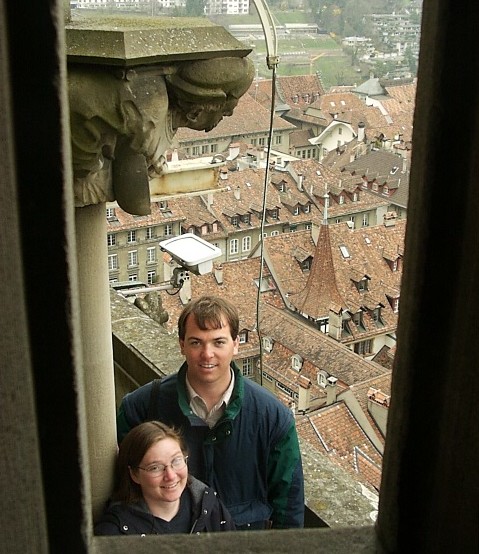
The Munster is rather elaborate. This, for instance, is a gutterspout.
If it were raining there would be a flood of water coming out of this
statue's mouth and I would not be standing underneath it taking this
picture.

Inside the cathedral the highlight are the stained glass windows which
once again depict a favorite Swiss topic: the Dance of Death. Many of
the sculptures that are located high on the walls of the Munster are
original, those that were lower down were primarily destroyed during the
Swiss Reformation.

The real highlight of the cathedral though is the tower. From the
lofty heights you can look back down on the square outside and this
fountain featuring a statue of Moses pointing to the commandment which
forbids idolatry - built during the Swiss Reformation of course. All
fountains in all Swiss cities are safe drinking water for human consumption,
so of course it's okay for dogs as well. Most fountains do in fact have
a lower drinking area like this one in dog-friendly Switzerland.

The climb to the top of the tower is not for the faint of heart. An
initial stone staircase leads out to a high platform from which another
spire with an exceedingly tight spiral staircase ascends to the top.
There are 254 stairs in all. The top section features long narrow
windows that extend down to the stair you are standing on which gives
the unnerving illusion that you could walk right off the edge. Actually,
you could if you were narrow enough. It was rather hazy on the day we
went to the top but as you can see the view is still worth the effort.

This is the view of the Munster from across the river, with scaffolding
of course. (But no crane other than the one on the far right). The
enormous stone platform jutting out from the near side of the cathedral
is the Munsterplattform and took a hundred years to build in the 14th and
15th centuries.

This is the reverse view of the previous one - looking at a bridge over
the Aare river from the top of the Munster. Just across this bridge is
a small square filled with an assortment of museums. We visited the
Bern History Museum primarily because it holds the Burgundy Tapestries.
Periodically, such as while we were visiting, these tapestries are displayed
in dim lighting (rather than practically no lighting) so that they can be
viewed in detail. Some of these tapestries are unbelievably large. A
four-tapestry sequence on the life of Julius Caeser dominates an entire
gallery. Also off this square but not visited by us are the Natural History
Museum which supposedly features the stuffed remains of some of the original
Swiss Mountain rescue dogs and the Swiss Alpine Museum featuring
(drum roll) ... dioramas of the Alps.
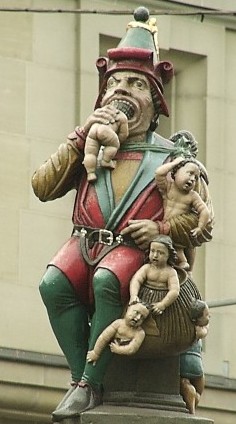
This is known as the Ogre fountain and since we had to show a close-up
of some fountain sooner or later, it might as well be this one. Just for
the record, yes, he is in fact devouring small children. It is more
interesting than certain famous fountains in say, Brussels though.

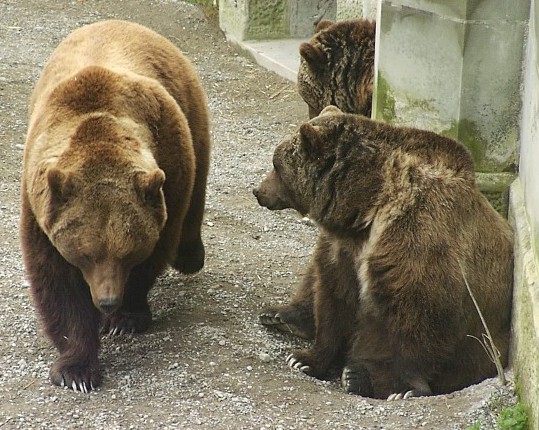
Here it is, the symbol of Bern. Legend has it than when the Duke Berthold V
arrived in 1191, the first animal he killed while hunting was a bear ('Barn'
is the dialect of the time) and thus the city got its name. Just across a
bridge from the center of town are the bear pits of Bern, a tradition ever
since (Actually it dates from around 1440).

There are two bear pits although all three bears were in the same one
while we were visiting. There is a nice view of Bern from the bear pits
and an even nicer view from the top of the hill above the pits, where
the Bern Rose Garden is located.

Of the cities we visited in Switzerland, Bern is probably the place where
we could spend the most time. There are numerous other museums that we
did not visit and one could easily spend a couple days wandering through
the streets. It's a fairly pricey place to stay but no more expensive
than Zurich or Lucerne and the transportation costs once you get there are
non-existent.