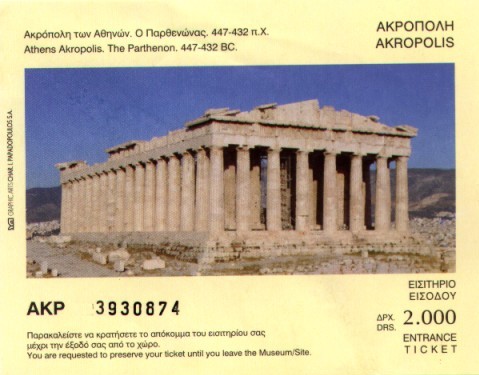
The Acropolis ("high-city") of Athens contains quite a bit more than just the Parthenon.
There were an assortment of buildings atop the plateau at one time and several more
scattered around the slopes. The Theater of Dionysus is one of the oldest theaters in
Greece and very little remains of it today. Nearby is the Odeion of Herod Atticus - the
theater shown here. This is set at the base of the Acropolis and is one of the first things
you'll see after you enter the main gates. One other thing you can see just outside the
main gates is the world's most expensive snack bar. Seriously, we paid the equivalent of
$3 for a small Fanta. On the other hand, there are a lot of steps to get up there and we
were thirsty, so there wasn't much choice in the matter.

The theater, you may notice, is restored and is apparently used for special
occassions. Notice also the line of tour buses beyond it. We were told from
several sources that the best time to visit the Acropolis is early in the
morning in the early Spring or late Autumn. Well, here we are in early Spring
first thing in the morning. We aren't complaining though because we saw pictures
of the high season and it was just a mass of humanity up there. It's just not
the sort of place you can expect to have a quiet moment with the Greek deity of
your choice. (Those are later in the trip.) Wandering amongst the tour groups is
interesting though because you can hear clips of the narration in pretty much
every known language.

This is the west face of the Parthenon with the scaffolding clearly visible inside.
The Parthenon has had quite the history over the years. Originally a Greek temple to
Athena (the patron of Athens), in the 5th century AD it became a church
eventually part of the Eastern Orthodox Church. Later it spent a couple
centuries as a Muslim Mosque. It was damaged in several earthquakes over the
centuries but the worst damage was done in the 17th century when Venetians hit
it with cannon fire as it was serving as a Turkish armory and gunpowder
repository at the time. The gunpowder repository had also been ignited by
lightning at least once previous to that. The friezes that once covered the
entire top sections are partially in a museum nearby and partially in the
British Museum in London. The Turkish government in 1801 gave Lord Elgin
permission to take whatever he wanted and he did, selling it to the British
Museum in 1816. The Greeks are still rather unhappy about the whole thing and
there is a constant movement to have the Elgin Marbles returned to Athens.

The Acropolis is one of several hills in Athens but it is not the highest. That
honor belongs to Lykavittos Hill, seen here in the background. It is crowned
with a Byzantine monastery and a popular restaurant at the top of a cable car
run. Athens also sits in a horseshoe shaped valley, surrounded by much higher
mountains, though they were hard to see for the most part through the smog. The
Acropolis is in the process of being reconstructed as is nearly every other
site we visited in Greece. Wandering around the area there are pieces of marble
columns, pedestals, engraved tablets and carved sections from the original roof
lying about everywhere. The Propylaia, or entrance to the Acropolis, was under
the most intense renovation while we visited and so we have no particularly
interesting pictures of it. That is also where the picturesque Temple of Athena
Nike is found.

This is how Athens looks from above. The view is fairly similar in all directions.
The Greek government has tried a few things to combat this pollution. One of the more
interesting was a law that vehicles with odd-numbered license plates could only
drive on odd-numbered days and vice-versa with even numbers. Instead of people
taking more to public transportation, the plan backfired and many citizens just
went and bought a second car, leading to the same amount of traffic but more
parking problems.

The Parthenon was built primarily by the architects Iktinos and Kallikrates.
Inside was an enormous statue of Athena sculpted by Phidias, who we will deal with
in more detail when we get to Olympia. The building itself incorporated several
interesting design elements aimed at preventing the normal optical illusions
from operating. For instance, the long sides of the building are actually
slightly concave so that the columns appear to be in a straight line when viewed
from a distance. The columns themselves are slightly fluted so that the lines
appear to be straight as well. As a result there are very few actual straight lines
incorporated in the design, yet when one looks at it from just about any angle
it appears to be perfectly square in all dimensions. Apparently, Iktinos and
Kallikrates knew what they were doing.

Here is the east face where you can see all those principles at work. Legend has
it that at the founding of the city, Athena and Poseidon competed over who would
become the patron God(dess). Poseidon struck his trident against a rock atop the
Acropolis and water came out in the form of a spring. Athena created an olive
tree which would bear fruit forever. Athenians (as you may have guessed) chose
Athena and her olives. They really like olives. We've seen the rest of Greece,
and there's plenty of olive trees but not much in the way of fresh water, so I
think maybe we'd have voted for Poseidon. Then again, Poseidos doesn't have
the same ring to it.

Before we depart the Acropolis, we have to stop at the Caryatids. The porch of the
Caryatids seen here is on one side of the Erectheon. The Erectheon stands on the
site of a more ancient temple (pre-Greek) which was dedicated to a God named
Erectheus. It's been lost through the years what exactly he was god of, possibly
Athens, but in Greek times he was eventually merged with Poseidon. Inside this
building one could find the spring Poseidon caused to well up and the olive
tree is just outside it. (Although replanted by Queen Sophia in recent times.)
If the back right Caryatid looks a little different, that's because the original
was lost and had to be resculpted. One of the other five is a reproduction, as
the original was also spirited away by Lord Elgin. The other four originals are
courtesy of Alkamenes, a student of Phidias.