On Tuesday we returned to Venice, this time to spend the entire day there.
We found it to be rather crowded during the day, and many of the major
sights had extensive lines. The Accademia gallery for instance, is only
open 3 hours a day and the line to get in may have been that long.
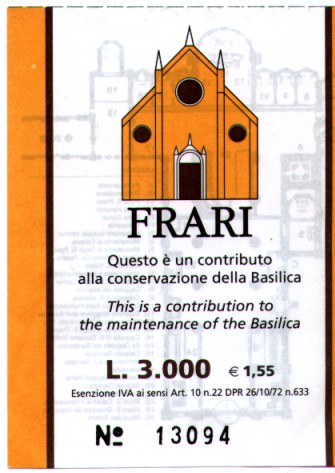
We had no problems getting into the Santa Maria Glorioso dei Frari however.
A massive gothic church found somewhere in the maze of alleys.
The very recognizable painting over the altar in this photo is Titian's
'Assumption'. Titian is also buried inside the church. The church
also contains works by Bellini and Donatello and an impressive room of
religious relics.

We spent the rest of the morning wandering the section of Venice called Dosoduro.
It was in this section of town that we entered our first osteria.
An osteria is basically a wine bar that serves appetizers as well.
If you're willing to stand at the bar, you can drink wine for about 2000-3000 Lire
per glass (about $2). Thus we decided to try and avoid the dinner prices
by having a large lunch and then appetizers (and gelato) for dinner.
We highly recommend this approach - most osterias also have tables though you'll
probably be charged a coperto (cover charge) for sitting at one.

This is the grand canal from the Ponte dell'Accademia. The canal in the
previous picture is about the size of the majority of canals in Venice. The
Grand Canal is much wider and deeper and runs through the center of town in a
reverse-S shape.

This photo shows one end of the Grand Canal where it empties into the lagoon on the
south side of Venice. The huge building on the right is the Basilica di Santa Maria
della Salute. The Accademia bridge from which we took these pictures is one of only
three bridges in Venice that cross the Grand Canal. This makes navigation even more
difficult. There are actually signs in various alleys that say things like 'Rialto'
and 'San Marco'. They are then followed by an arrow which has had both ends scratched
off so that you can't actually tell which way is correct.

Another random canal in Venice. This one is most significant as the site where
Melanie's camera died. We're not sure what happened but it took a series of
continuous pictures before spitting the film out all over. Further pictures
taken by Melanie are courtesy of an overpriced single-use camera.

This is one of those pictures. The famous bell tower of Venice with the
Basilica of San Marco behind it to the left. This is Piazza San Marco,
also know as St. Mark's Square. For a mere $6-$7 you can sit at an outdoor
cafe here and have a cappucino. If that isn't pricy enough, for $2 you can
buy a handful of seeds to feed to the raging horde of pigeons that share the
square with tourists. For the most part we took a few pictures and then fled
to quieter parts of Venice.

Here is a closer view of the basilica. This basilica was built in the 11th century
and originally served as the private chapel of the Doges. Now it's the cathedral
of Venice.

For less than the cost of a cappucino, you can take the elevator to the top
of the bell tower. This is a picture from the balcony, showing a top view of Venice.
This is looking west towards the mainland of Italy. The causeway which connects
Venice can be seen on the left, and in the far distance, the Alps can be seen.
The canals are difficult to pick out from above as they are so narrow. The Grand Canal
is off to the left and cannot be seen.

The other direction you can see several of the smaller islands that dot the lagoon,
including Lido, Murano, and San Michele. But instead of that picture we prefer this one,
looking down at the waterfront from the bell tower. San Marco seems to be the most
popular location to hire a gondola at.

This is the same scene from ground level with the Santa Maria Basilica in the background
again. The riverfront along here is filled with people selling just about everything
imaginable. The expected watercolors, leather goods and carnival masks are joined by
stuffed animals, mechanical dogs, and sports memoribilia.

Between San Marco and the waterfront are these two columns. The one
on the left is the lion of St. Mark, and the one on the right is St. Theodore
which are the two emblems of Venice. The bell tower in the background is
not the one in San Marco. That clump of buildings actually lies across the
water from Venice proper on the island of San Giorgio Maggiore. The basilica
on that island was designed by Palladio (more on him on the next page) in the
16th century.

Connecting the Doge's Palace and the old prison is the Ponte dei Sospiri.
The higher enclosed bridge in the foreground which is known in English as
the Bridge of Sighs. Legend has it that the sighs of prisoners being led
into the dungeons could be heard as they crossed the bridge. Casanova
was among the more famous to make this trek. At night, Venice becomes
less crowded and even more picturesque. We returned to the aforementioned
osteria to try out a few local wines and lest you think we forgot, we had some
more gelato on the way back to the bus station. This time it was
vanilla,
walnut, and
tiramisu.