On Monday morning we headed out of Milan, which takes quite a while as
none of the autoroutes come particularly close to the city center. Our
first stop was the village of Capriate San Gervaiso on the banks of the
Adda river. Just outside of this town is a village called Crespi D'adda.
Not exactly highly touted in most tourist guides, it was designed at the end
of the 19th century as an 'ideal working town'. The centerpiece is
a cotton mill along the river which is where all of the residents of the
town worked. Houses fill up the center of town with the managers'
homes being slightly larger and slightly farther out of the center of town.
The main road contains everything that was considered necessary to keep
the residents happy: a co-op store, a church, a school, a park, a
castle built specifically for this town, and the mausoleum shown here,
as a monument to the city's founder.

Each home designed for a worker and his family was exactly the same - a two-story
cube-shaped home set in the center of a square lawn with plenty of room
for a garden. Today, the mill is used in part as a factory and people
still live in the town. The homes can be seen in this photo in a
variety of colors.

After Crespi, we continued on to Padua stopping along the way at an Autogrille.
Autogrilles are placed every few miles along Italian highways and despite
warnings from Italian friends to avoid the food there, we found the panini
to be exceptional. (Well, compared to anything you'd find at an American
rest area.) Arriving in Padua, we promptly got lost and spent some
time driving around in circles (literally). The major difficulty
is the wide plaza shown here. On maps, and in reality it is called
the 'Prado della Valle'. We translated this as 'meadow of the valley',
and thus we continued looking for a huge meadow basically. Eventually
we figured this out.

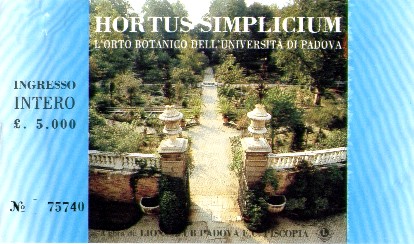
Just off the Prado della Valle is the Orto Botanical Gardens. Purportedly
the oldest botanical gardens in Europe, it is by far the most extensive
we've ever visited. The gardens are divided into over 20 sections,
most of them devoted to a single family of plants. In many cases
each variety of every plant in a family is displayed. This can actually
get tedious after you've seen all 237 varieties of sage but it is impressive.
This photo is of the front gates with the spires of the Basilica del Santo
in the background

These flowers were found in the alpine rock garden section. We lost the map to
the gardens shortly after our return, and unfortunately we had written down the
flowers we had photographed on the map. Over a year later the map reappeared,
but now we're not completely certain of the order. As best we can tell, this
is a species of Iberis.

Here we have another lovely flowering thing that we think is a species
of Mimosa. We do recall that it was extremely rare for one of these to
flower, whatever it might be.

This circular fence in the foreground of this picture surrounds one of the
four major plant groups. It doesn't really matter which one, unless you're
a botanist,in which case you should already know just by looking at it. If you
are a botanist, please email us and tell us what it is.

One of the flowers here (either the red or the lavender) are
anemones. The other are aubrieta. We might mention that these
names are also in Italian only, so other than spices and particularly
common flowers, we probably don't know what we're talking about in
English anyway.

Here we have an extreme close-up of ... some purplish flowers.
These are either pulmonaria or myostros. It could be a quiz in fact,
but it would be a very very difficult quiz for the average reader.
Also, we don't have the answers. Pretty though, aren't they?

After we left the gardens, we drove out of Padua and proceeded on to Marghera,
across the water from Venice. We stayed in Marghera at the Hotel
Roma, which we recommend very highly as a cheap place to stay while visiting
Venice. Furthermore they were very friendly and helpful (and gave
us free food). That said, we will also mention that Marghera is a
city made up almost entirely of rotaries. Driving there is almost
like being on one of those spinning tea-cup rides at an amusement park.
We took a bus from the hotel to Venice proper which is far cheaper than
actually trying to park in Venice. It was dark and raining lightly
when we arrived in Venice, but it really doesn't matter. Seeing the maze
of alleys, canals and bridges for the first time completely overrides any
objection to being vaguely damp. We also found an open gelato store
and picked up some
mint
and
chocolate
to add to our collection. After what seemed like hours, we found our
way to St. Mark's square (pictures coming on the next couple pages) which
was dark and deserted, and in retrospect was rather nicer that way.
We found a ludicrously over-priced restaurant to eat at before taking a
vaporetto (water-bus) back down the Grand Canal and returning to Marghera.
We now realize that all restaurants in Venice are ludicrously over-priced,
but we would discover how to avoid this by the time we left. (That's
a meager attempt at a hook to make sure you anxiously read the next page
now to discover the answer).